There are no items in your cart
Add More
Add More
| Item Details | Price | ||
|---|---|---|---|

A woman sits across from a friend at lunch.
As they talk, she casually mentions that she wakes up tired most mornings.
Her friend nods.
"So do I."
She talks about the afternoon slump that hits around three o'clock.
Her friend nods again.
"Me too."
Then she mentions that she feels stressed most days, struggles to fully relax, and can't remember the last time she felt truly energized.
Again, her friend nods.
Neither of them seem alarmed.
In fact, the conversation moves on.
Because what they are describing has become normal.
Not necessarily healthy.
Not necessarily ideal.
But familiar.
And sometimes familiarity can be mistaken for wellness.
This is one of the most fascinating aspects of being human.
We adapt.
We adapt to circumstances.
We adapt to environments.
We adapt to routines.
And perhaps most surprisingly, we adapt to conditions that may not actually be serving us.
Over time, what once felt uncomfortable can begin to feel ordinary.
What once felt temporary can begin to feel permanent.
And what once felt unacceptable can slowly become our new baseline.
The remarkable ability to adapt helps us survive.
But it can also prevent us from noticing when something needs to change.
The Frog We Never Notice
There is a well-known metaphor about a frog placed in water.
If the water suddenly becomes hot, the frog immediately reacts.
But if the temperature rises gradually, the change can be difficult to notice.
Whether or not the biology of the story is accurate isn't the point.
The lesson is.
Human beings often respond the same way.
Sudden changes grab our attention.
Gradual changes often slip beneath it.
Few people wake up one morning and suddenly become overwhelmed, exhausted, disconnected, or unhealthy.
Most arrive there through small increments.
Five pounds becomes ten.
Occasional stress becomes chronic stress.
A late bedtime becomes a lifestyle.
An afternoon of scrolling becomes hours.
The changes happen slowly enough that the nervous system adjusts along the way.
And because the adjustment is gradual, awareness often fades.
The Brain's Desire for Familiarity
One reason adaptation is so powerful is that the brain is constantly trying to create efficiency.
The brain loves patterns.
Patterns reduce uncertainty.
And uncertainty requires energy.
As a result, repeated experiences eventually become familiar, and familiar experiences require less conscious attention.
This process is incredibly useful.
It allows us to drive a familiar route without thinking about every turn.
It helps us learn skills.
It conserves mental resources.
But it also means that repeated stress, tension, and discomfort can eventually become background noise.
The body may still be experiencing them.
The brain simply stops highlighting them.
Researchers studying perception call this habituation.
The nervous system becomes less responsive to repeated stimuli over time.
What was once noticeable becomes easy to overlook.
And this applies not only to physical sensations but also to emotional and psychological experiences.
We can become accustomed to worry.
Accustomed to overwhelm.
Accustomed to dissatisfaction.
Accustomed to feeling disconnected from ourselves.
Not because these experiences are healthy.
But because they have become familiar.
When Survival Becomes Identity
This pattern is particularly common among people who have spent years serving others.
Caregivers.
Parents.
Veterans.
Leaders.
Professionals responsible for many moving pieces.
At first, pushing through may be necessary.
A season of intense effort.
A period of sacrifice.
A time when responsibilities genuinely require more attention.
But what begins as a temporary adaptation can eventually become an identity.
The person who handles everything.
The one who keeps going.
The one who doesn't complain.
The one who figures it out.
Over time, the nervous system becomes so accustomed to operating in high gear that slowing down begins to feel unfamiliar.
And what is unfamiliar often feels uncomfortable.
Not because it's wrong.
But because adaptation has reshaped expectations.
The Body Continues to Communicate
One of the most beautiful truths about the human body is that it never stops communicating.
The challenge is not that the body becomes silent.
The challenge is that we stop hearing it.
The body speaks through energy.
Through sleep.
Through digestion.
Through focus.
Through mood.
Through cravings.
Through tension.
Through vitality.
Or the absence of it.
Yet many people interpret these signals as problems to suppress rather than messages to explore.
A headache becomes something to push through.
Fatigue becomes something to overcome.
Brain fog becomes something to tolerate.
The signal gets managed.
But the message often remains unread.
The body keeps communicating anyway.
Patiently.
Repeatedly.
Waiting to be noticed.
Nature Offers a Different Lesson
When we look at nature, adaptation and restoration exist together.
Trees adapt to changing seasons.
But they also shed.
Animals adapt to environmental shifts.
But they also rest.
The ocean adapts to weather.
But it continues to move in rhythms.
Nature rarely asks a living system to remain in one state indefinitely.
There is movement.
Adjustment.
Recovery.
Renewal.
Yet humans often expect themselves to remain productive, available, responsive, and engaged without interruption.
We admire adaptability.
But sometimes forget the importance of recalibration.
The Cost of Unquestioned Adaptation
Adaptation becomes problematic when it prevents awareness.
When people stop asking:
How do I actually feel?
Is this serving me?
Have I accepted something that deserves attention?
Have I mistaken familiarity for normalcy?
This question applies far beyond health.
It applies to relationships.
Work environments.
Personal habits.
Thought patterns.
Emotional responses.
Even self-worth.
The longer something exists, the more likely we are to assume it belongs there.
But duration does not equal necessity.
Just because something has been present for years does not mean it should remain unquestioned.
Waking Up to What Has Become Normal
Many transformations begin with a simple realization.
Not a dramatic breakthrough.
Not a life-changing event.
Just awareness.
The recognition that what has become normal may not be optimal.
That exhaustion is not a personality trait.
That chronic stress is not a badge of honor.
That feeling disconnected is not an inevitable part of adulthood.
Awareness creates possibility.
Because we cannot change what we do not notice.
And often the first step toward change is not action.
It is observation.
The willingness to see clearly what has gradually become invisible.
Final Thought
Human beings are remarkably adaptable.
It is one of our greatest strengths.
But wisdom lies in occasionally asking:
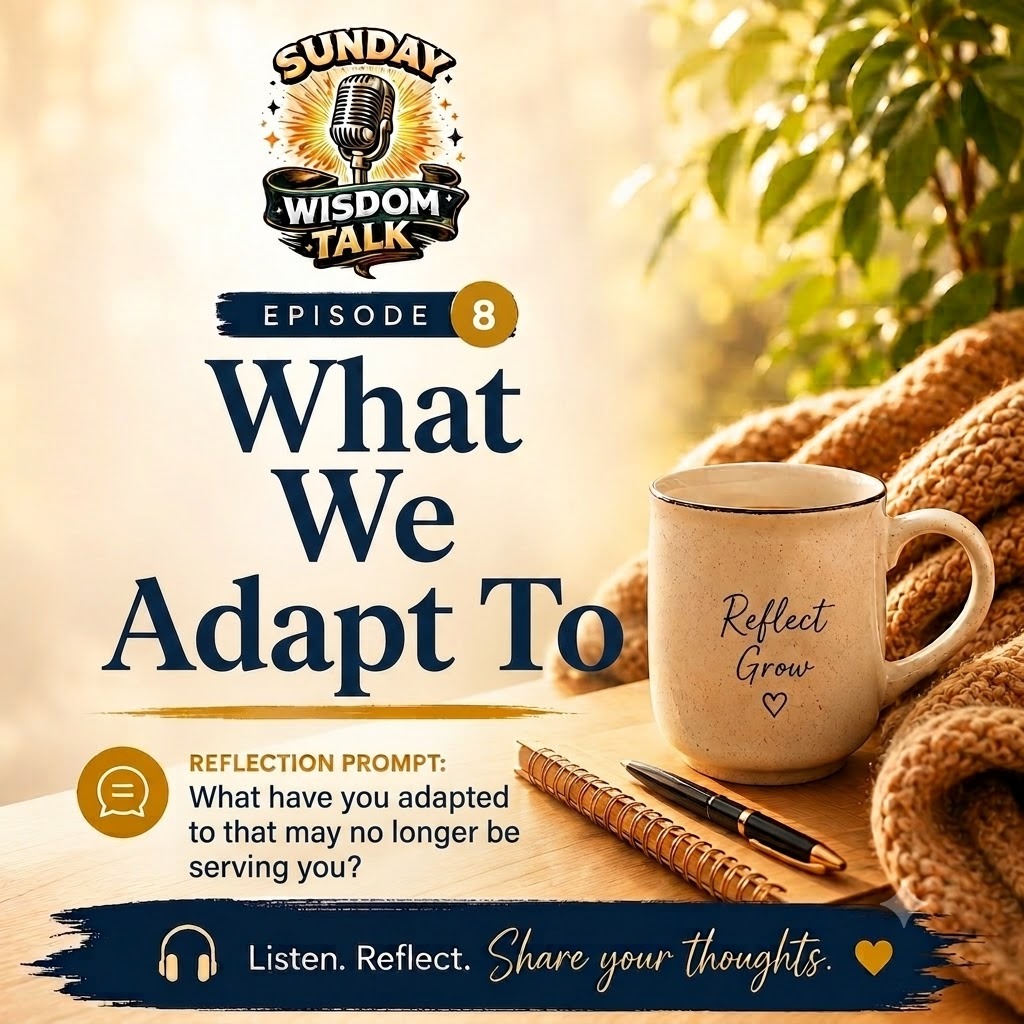
What have I adapted to that no longer serves me?
What have I accepted as normal simply because it has been present for so long?
And what might become possible if I noticed it again?
Because not everything we adapt to is meant to become permanent.
Sometimes growth begins the moment we become aware of what we've stopped noticing.
Take a moment to reflect on what has quietly become normal in your life.
Not with judgment.
Not with urgency.
Simply with curiosity.
What have you adapted to?
And what might your body, mind, or spirit be trying to tell you now?
Take a moment to pause with this reflection.
Take a moment to pause with this reflection.
If you’d like to experience this reflection in a more guided way, you’re invited to listen. Listen to the audio reflection
Invitation
If this reflection resonated with you, you'll find the audio version along with the complete Sunday Wisdom Talks collection inside the free Reset Community.
It's a growing library of reflections designed to help you pause, reflect, and explore life's deeper questions—one conversation at a time.
Access the free community and audio library here: Community Access
Written by Coach Lorraine Cuff
Sun, May 24th 2026.
 Launch your Graphy